


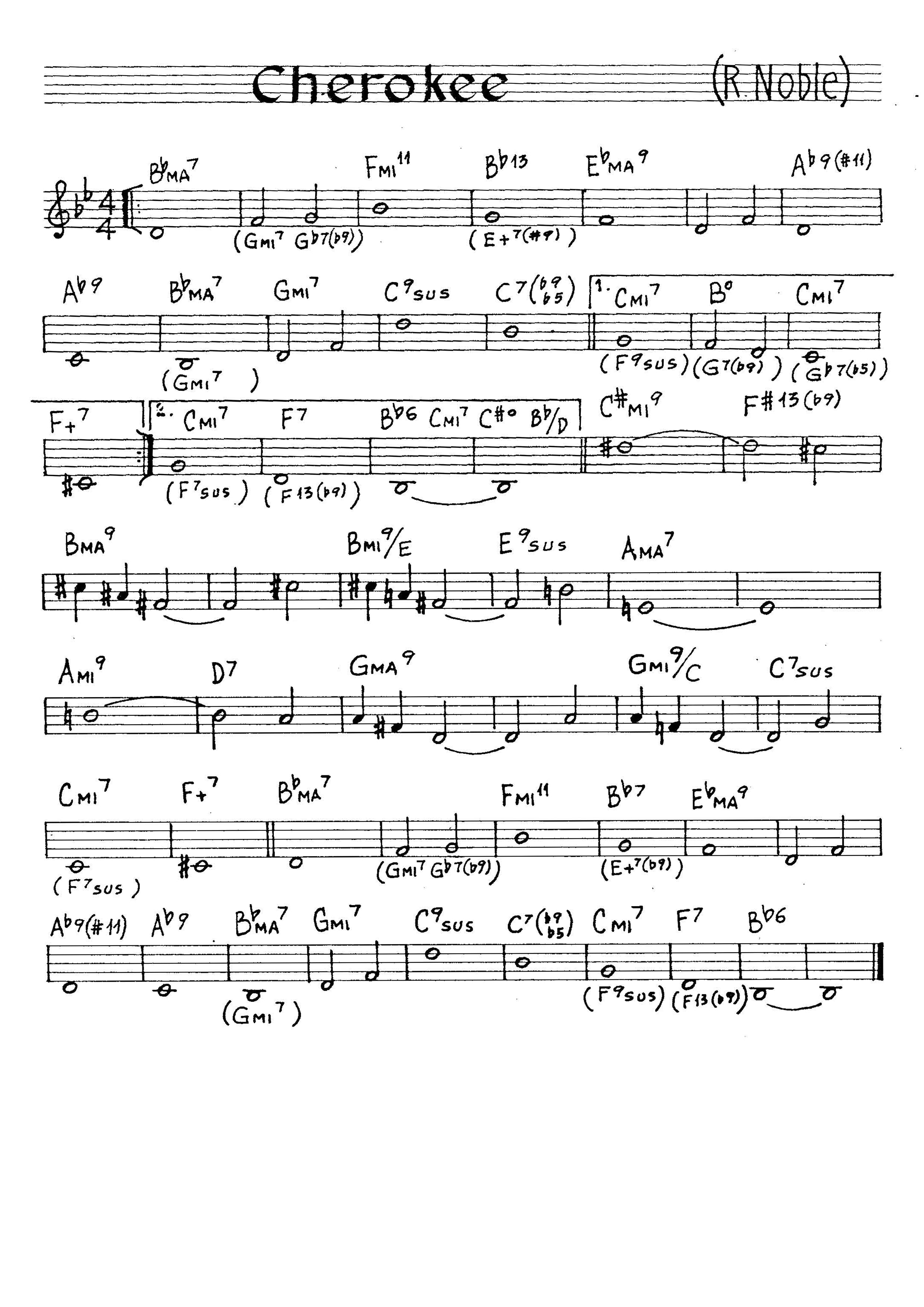

"Cherokee" (subtitled "Indian Love Song") is a jazz standard written by British bandleader Ray Noble in 1938 as the first movement of his five-part "Indian Suite." The composition became one of the most important vehicles in jazz history when Charlie Parker used its chord changes as the basis for his landmark 1945 recording "Ko-Ko."
The tune is a 64-bar AABA form in B♭ major—twice the length of a standard 32-bar song. While the A sections feature relatively straightforward swing-era harmony, the bridge presents a formidable challenge: it cadences through the keys of B major, A major, and G major via ii-V-I progressions before returning to the tonic. Navigating these rapid key changes at the blazing tempos favored by bebop musicians became the ultimate test of improvisational skill. Parker famously practiced the tune in all twelve keys during his development, and his breakthrough insight about using upper chord extensions as melody lines came while working on this very song.
Charlie Barnet and His Orchestra scored the first major hit with a swinging 1939 arrangement by Billy May. In the bebop canon, Charlie Parker's "Ko-Ko" (Savoy, 1945)—built on "Cherokee" changes with a partially improvised head—stands as one of the most revolutionary recordings in jazz history.
The Real Book (6th Edition)
The ultimate jazz fake book. A must-have for all gigging musicians.
Check on Amazon.com