


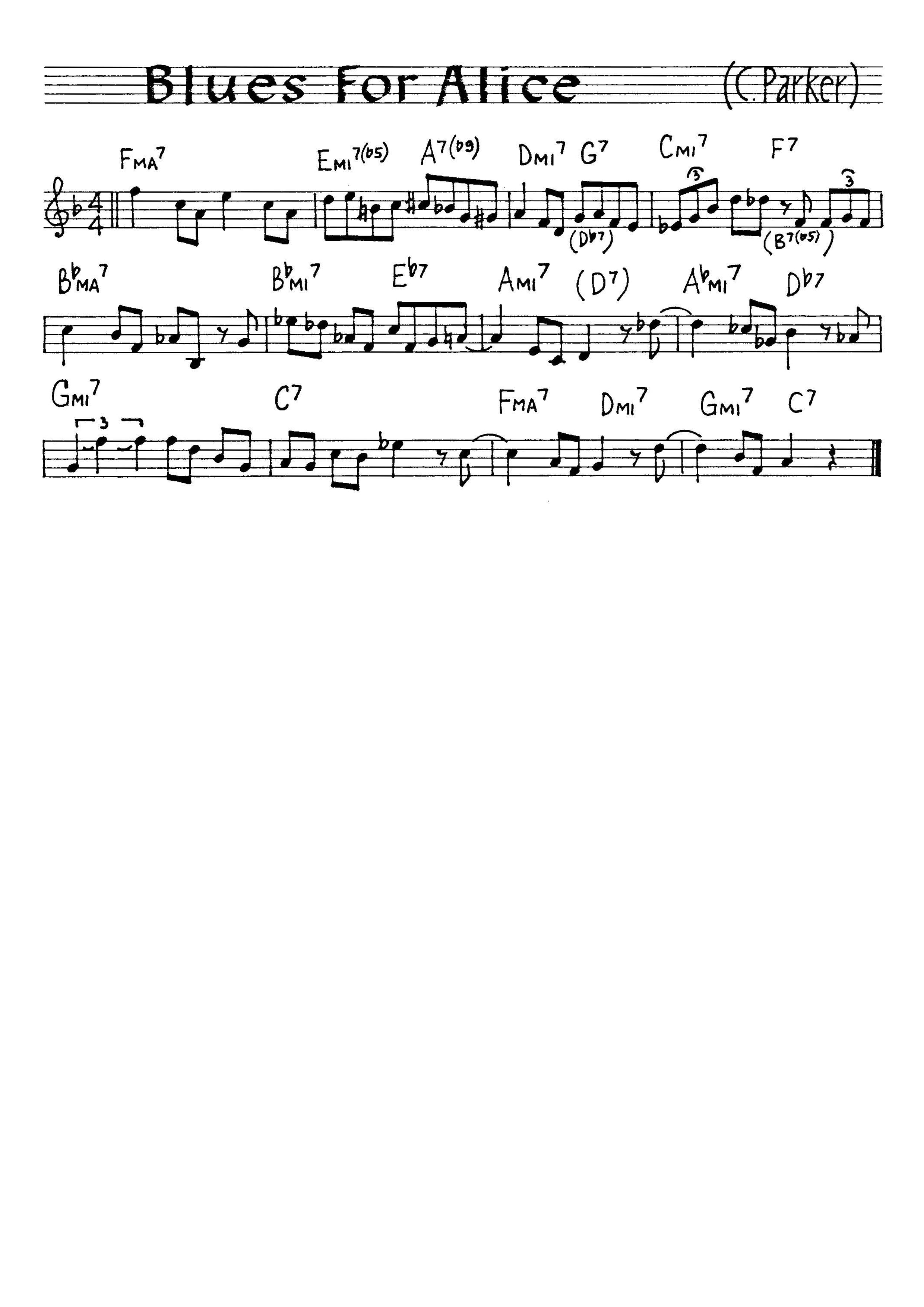

"Blues for Alice" is a 12-bar blues composition by alto saxophonist Charlie Parker (1920–1955), recorded on August 8, 1951, in New York City for the Verve label. The title's "Alice" is believed to refer to someone in Parker's personal circle.
Written in the key of F major, this tune is the quintessential example of what is known as the "Bird blues"—a bebop approach to the blues form that replaces the standard I7–IV7 changes with a sophisticated series of descending ii–V progressions. Beginning on Fmaj7 rather than a dominant seventh chord, the harmony moves chromatically downward through a chain of ii–V cadences before arriving at the subdominant. This descending ii–V pattern, often called "Bird changes," became one of the most important harmonic concepts in jazz theory. The composition demands advanced harmonic awareness from improvisers while retaining the emotional directness of the blues, making it an essential study piece for intermediate to advanced jazz musicians.
Parker's own 1951 Verve recording remains the definitive version. The tune has been a proving ground for generations of alto saxophonists including Phil Woods and Sonny Stitt, and it is a staple of jazz education as a vehicle for understanding bebop harmonic vocabulary within the blues form.
The Real Book (6th Edition)
The ultimate jazz fake book. A must-have for all gigging musicians.
Check on Amazon.com