


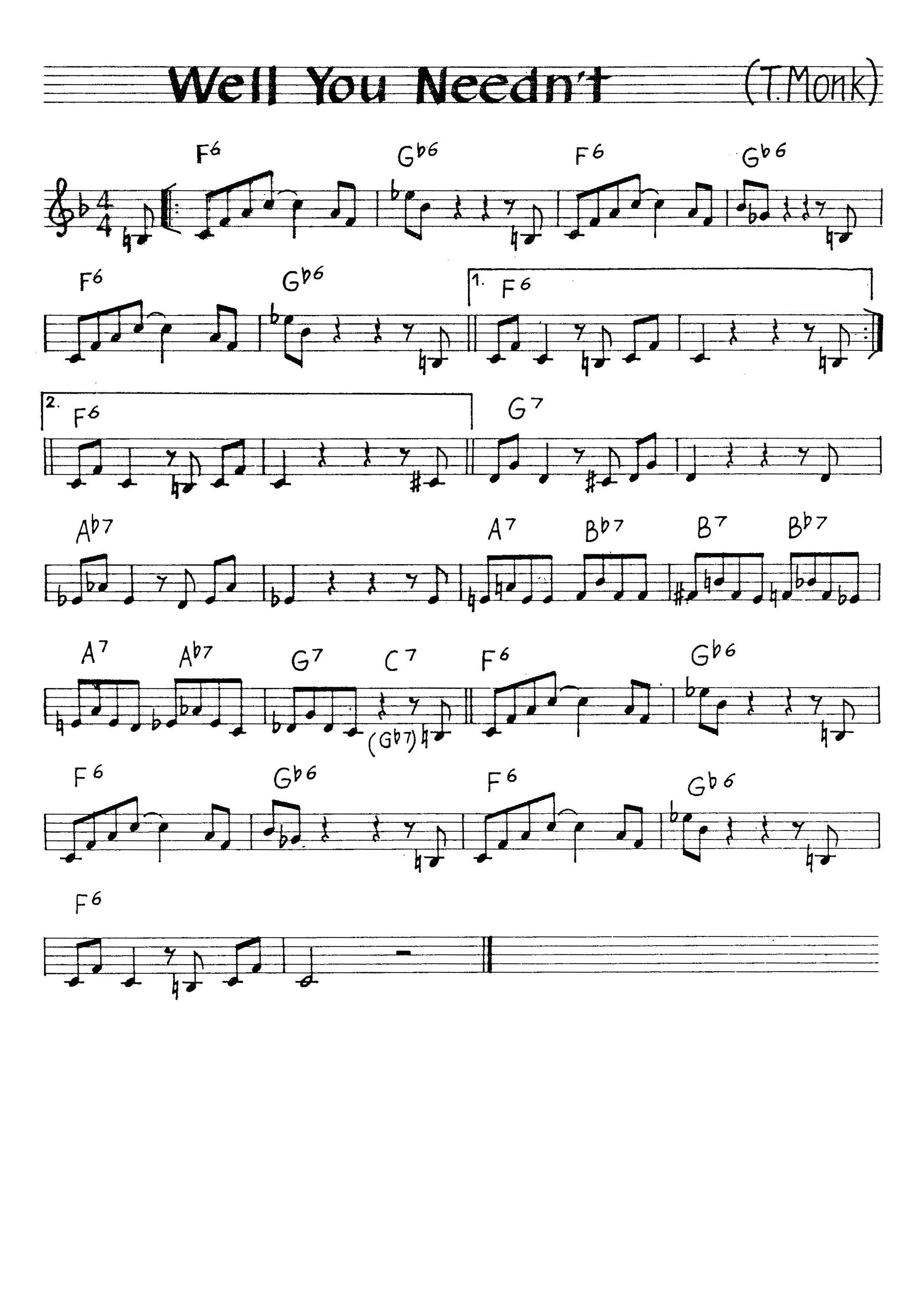

"Well, You Needn't" is a bebop classic composed by Thelonious Monk in 1944. The title originated from an exchange with Monk's student, singer Charlie Beamon: when Monk told Beamon he would name a song after him, Beamon replied "Well, you needn't"—and the name stuck.
Written in F major with a 32-bar AABA form, the tune's defining feature is its chord progression built on dominant 7th chords that move chromatically by half steps—a signature device that Monk also employed in "Epistrophy." The melody is rhythmically bold and angular, full of the unexpected leaps and offbeat accents that characterize Monk's compositional voice. There are two widely used sets of bridge changes: Monk's original, which features descending chromatic dominants from D-flat, and the version popularized by Miles Davis, which ascends from G7. The Davis version, disseminated through the Real Book, has become the de facto standard at jam sessions.
Monk's first recording from 1947, released on Genius of Modern Music, Vol. 1 (Blue Note), is the foundational version. Miles Davis's recording on Steamin' (recorded 1956, released 1961) established the alternate bridge changes and became equally influential.
The Real Book (6th Edition)
The ultimate jazz fake book. A must-have for all gigging musicians.
Check on Amazon.com