


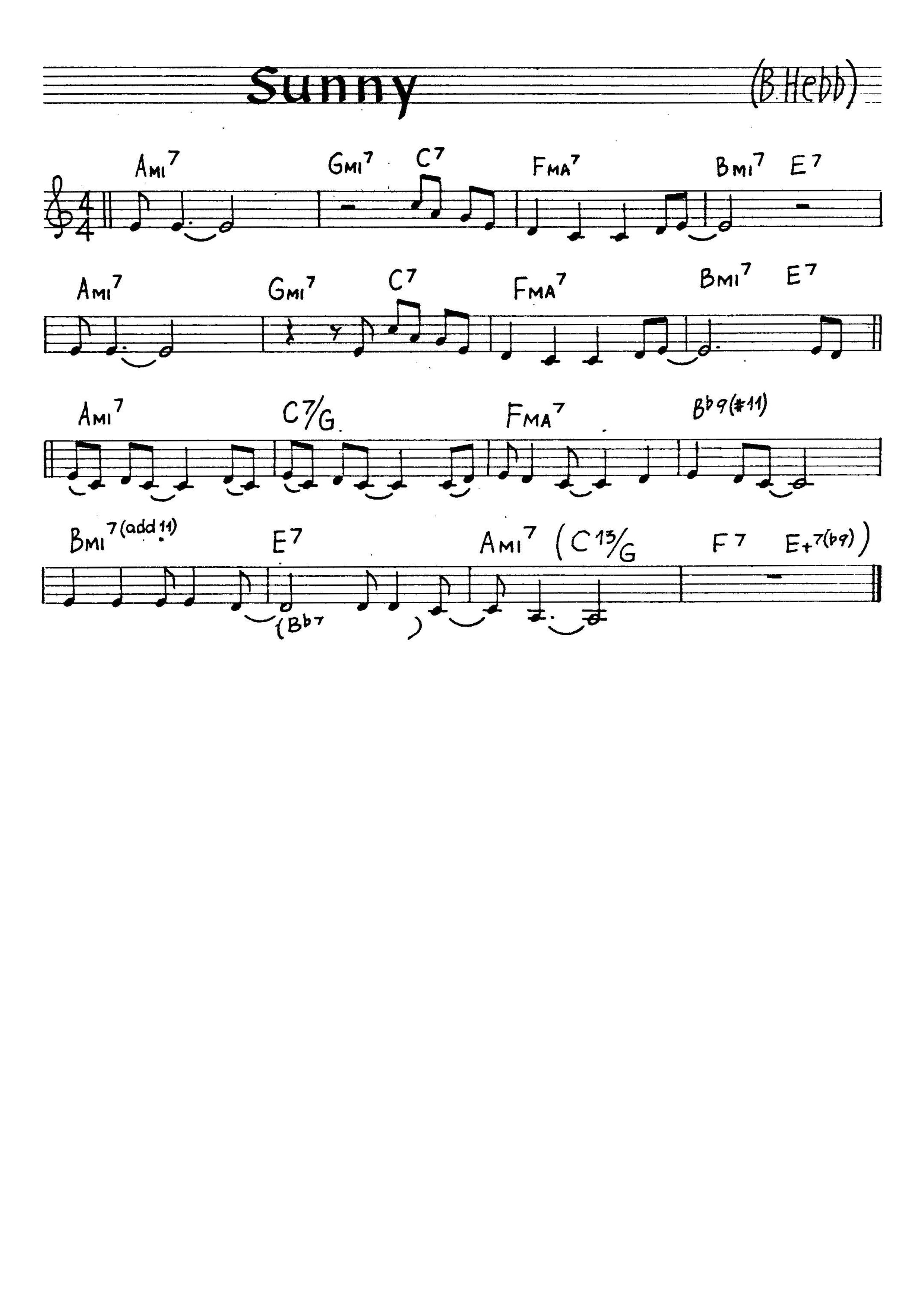

"Sunny" was written by singer-songwriter Bobby Hebb in 1963 and released as a single in 1966, reaching No. 2 on the Billboard Hot 100. Inspired by the tragic death of his brother Harold, the song channels grief into an uplifting message of seeking brightness in dark times.
The song has a 16-bar form built on a repeating four-bar chord loop: Im7–bIII7–bVImaj7–IIm7–V7. Hebb's original recording is in E minor with three half-step modulations through the verses, but jazz musicians typically play it in A minor without modulations. The harmonic identity rests on the tension between the minor tonic and the bVImaj7 chord, which creates a distinctive floating quality. Dominant seventh passing chords add a bluesy, soulful dimension. The progression's elegant simplicity has proven enormously influential, spawning derivatives in tunes like Freddie Hubbard's "Red Clay" and countless pop songs.
The landmark jazz recording is George Benson's 1968 instrumental version on Giblet Gravy, which demonstrated the tune's potential as an improvisation vehicle and helped bring it into the jazz repertoire. Pat Martino's guitar rendition is also highly regarded for its hard-bop approach to the changes.
The Real Book (6th Edition)
The ultimate jazz fake book. A must-have for all gigging musicians.
Check on Amazon.com