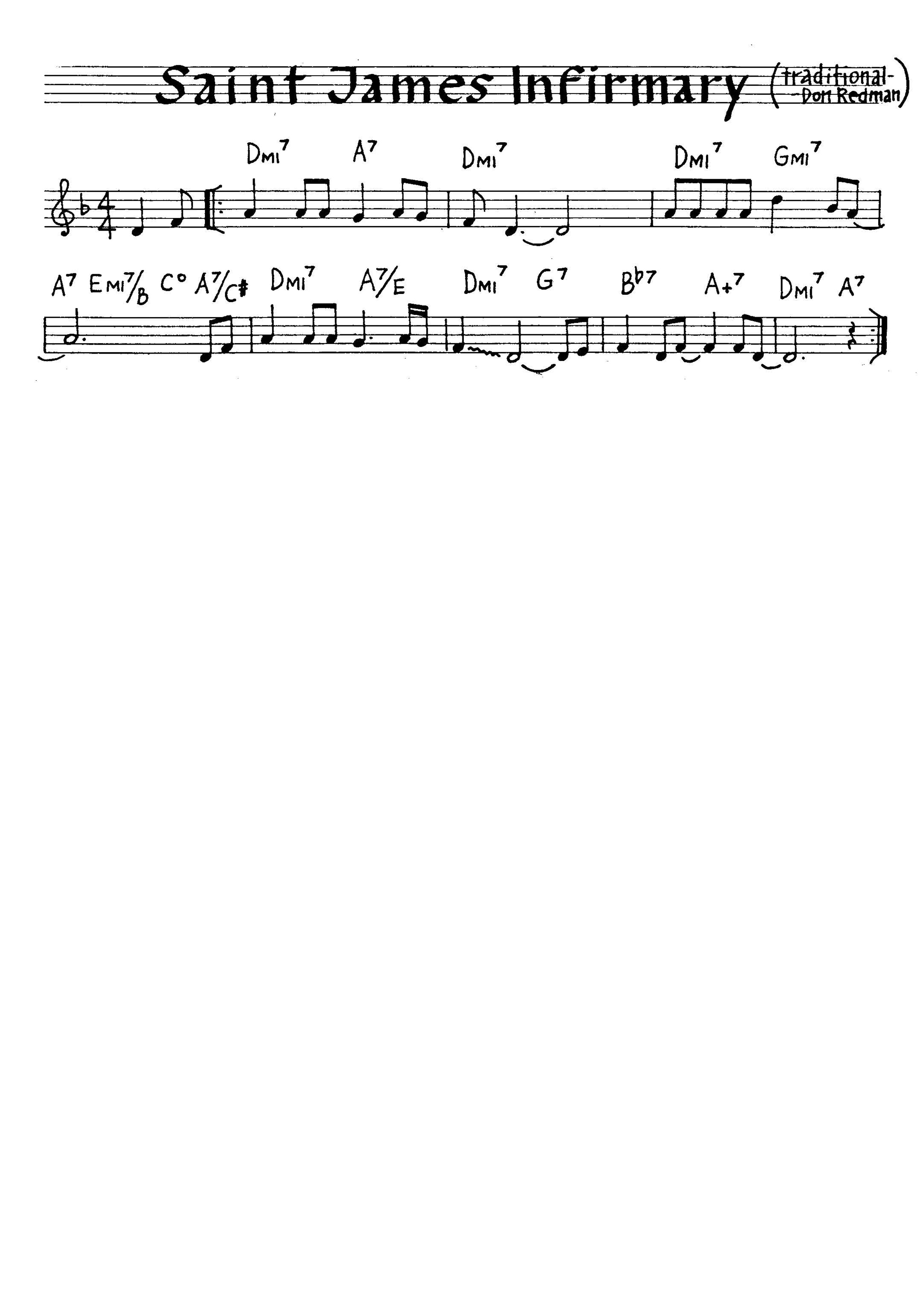
"Saint James Infirmary" is an American blues and jazz standard that emerged from folk traditions, with roots often traced to the 18th-century British ballad "The Unfortunate Rake." The song evolved through oral tradition before Louis Armstrong brought it to lasting fame with his landmark 1928 recording. Composer credit has been attributed to Don Redman and later to "Joe Primrose" (a pseudonym for publisher Irving Mills), though its origins are essentially traditional.
The tune is built on an eight-bar progression in a minor key (commonly Dm or Am), distinguishing it from the standard twelve-bar blues form. The stark, slow-moving harmony supports lyrics in which the narrator mourns a lover's death and requests a lavish jazz funeral for himself. The song can be performed as a solemn dirge or at a medium swing tempo, and its association with New Orleans jazz funeral traditions gives it an almost ritualistic quality. The simplicity of the form belies its emotional power—the minor-key melody and sparse chord changes leave ample room for dramatic vocal and instrumental interpretation.
The definitive recording is Louis Armstrong and His Savoy Ballroom Five's December 1928 session, featuring Armstrong's commanding trumpet solo and gravelly vocal. Cab Calloway's exuberant 1933 version, memorably animated in a Betty Boop cartoon, brought the song to an even wider audience. Bobby "Blue" Bland's 1961 rendition on Two Steps from the Blues offers a powerful blues-oriented interpretation that has become a classic in its own right.
The Real Book (6th Edition)
The ultimate jazz fake book. A must-have for all gigging musicians.
Check on Amazon.com