


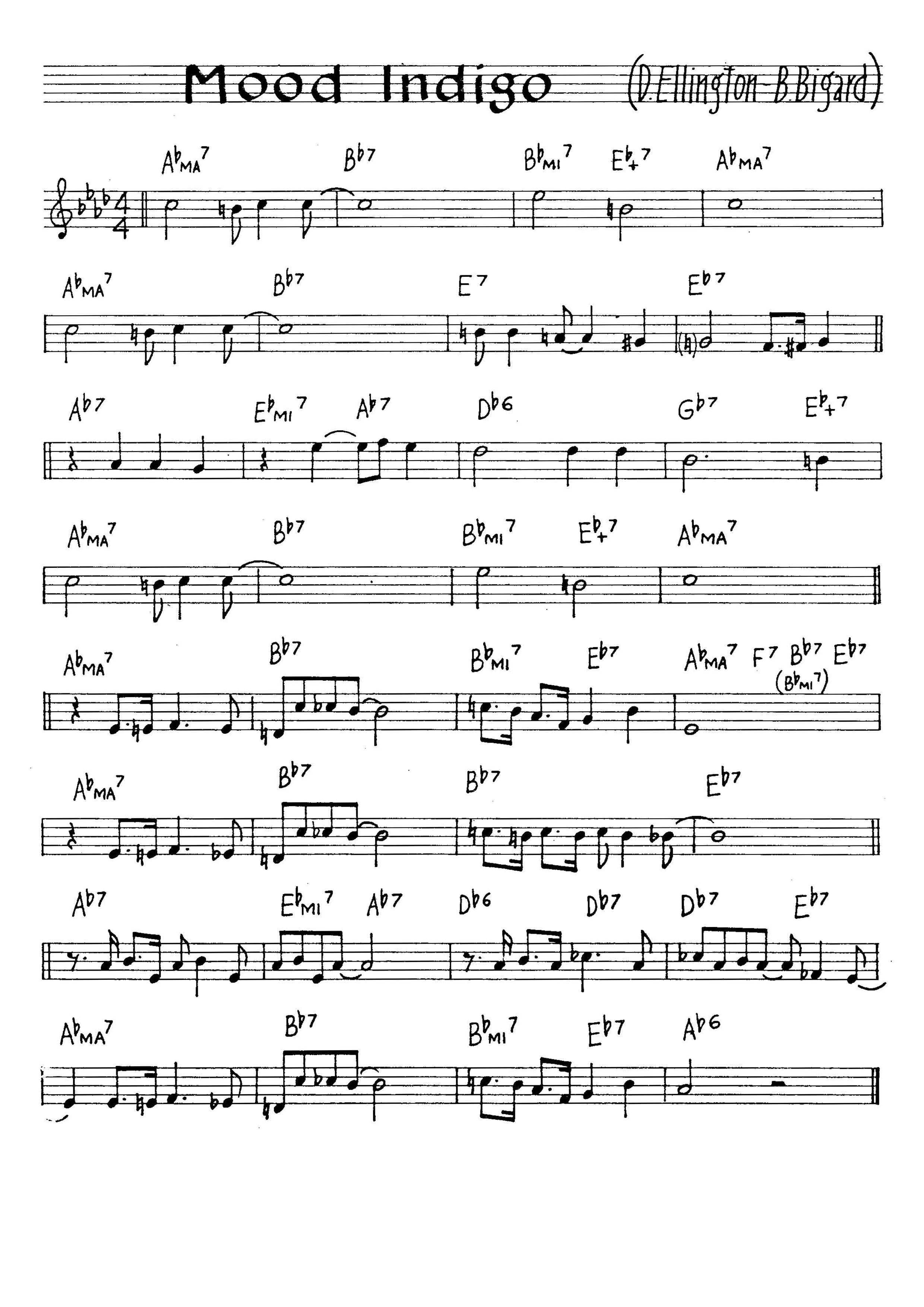

"Mood Indigo" is a jazz classic composed in 1930 by Duke Ellington and Barney Bigard. Originally titled "Dreamy Blues," it was written for a radio broadcast from the Cotton Club in New York City. Lyrics were later added by Irving Mills, and the piece became one of Ellington's most beloved standards.
The song has a distinctive two-strain structure, each 16 bars long, departing from the conventional AABA format. It is commonly played in A-flat. The true innovation lies in Ellington's groundbreaking voicing: he inverted the traditional horn arrangement, placing the trombone at the top of its register and the clarinet at the very bottom. The blend of muted trumpet, muted trombone, and low clarinet produced an overtone phenomenon known as a "mike-tone"—an auditory illusion of a phantom fourth instrument. This technique created the piece's hauntingly melancholy atmosphere and was a landmark in orchestral jazz arranging. Bigard contributed the iconic clarinet melody, adapted from a theme he had learned from his New Orleans teacher Lorenzo Tio Jr.
The first recording was made on October 17, 1930, by the Ellington Orchestra for Brunswick Records, featuring Arthur Whetsel (trumpet), Tricky Sam Nanton (trombone), and Barney Bigard (clarinet). The 1931 Brunswick release was inducted into the Grammy Hall of Fame in 1975. Ella Fitzgerald's 1958 vocal rendition and Charles Mingus's reimagined versions on Mingus Dynasty (1960) are also essential listening.
The Real Book (6th Edition)
The ultimate jazz fake book. A must-have for all gigging musicians.
Check on Amazon.com