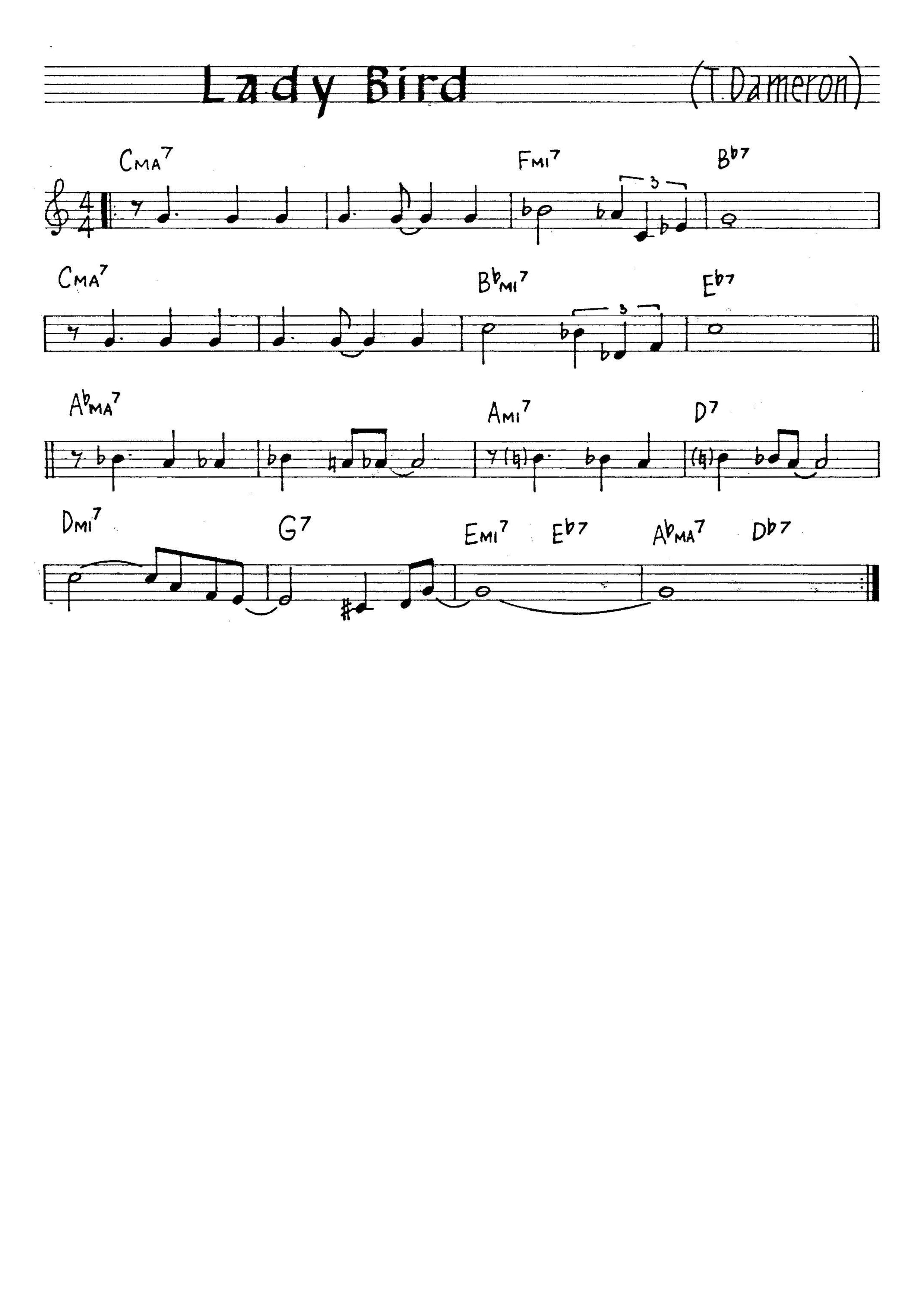
"Lady Bird" is a jazz standard written around 1939 by Tadd Dameron and first released in 1948. Dameron was one of the most important composer-arrangers of the bebop era, renowned for his elegant harmonic writing and lush orchestrations.
The tune is a compact 16-bar form (AABC) in C major, yet it packs remarkable harmonic sophistication into its brief structure. Each four-bar phrase uses ii-V progressions to briefly target tonal centers a third away from the tonic — E♭, A♭, and G — before the first two phrases resolve back home via a "backdoor cadence." The composition's crowning feature is the famous Tadd Dameron turnaround in the final two bars (Cmaj7–E♭7–A♭maj7–D♭7), a harmonic device that has become one of the most widely adopted progressions in jazz, influencing countless composers and improvisers.
Dameron's own 1948 Blue Note session with his Sextet is the essential recording, featuring Fats Navarro's brilliant trumpet work navigating the changes with bebop precision. Miles Davis admired the progression so much that he based his composition "Half Nelson" on it, and definitive versions by Dexter Gordon, Bud Powell, and Chet Baker further cemented Lady Bird as a bebop cornerstone.
The Real Book (6th Edition)
The ultimate jazz fake book. A must-have for all gigging musicians.
Check on Amazon.com