


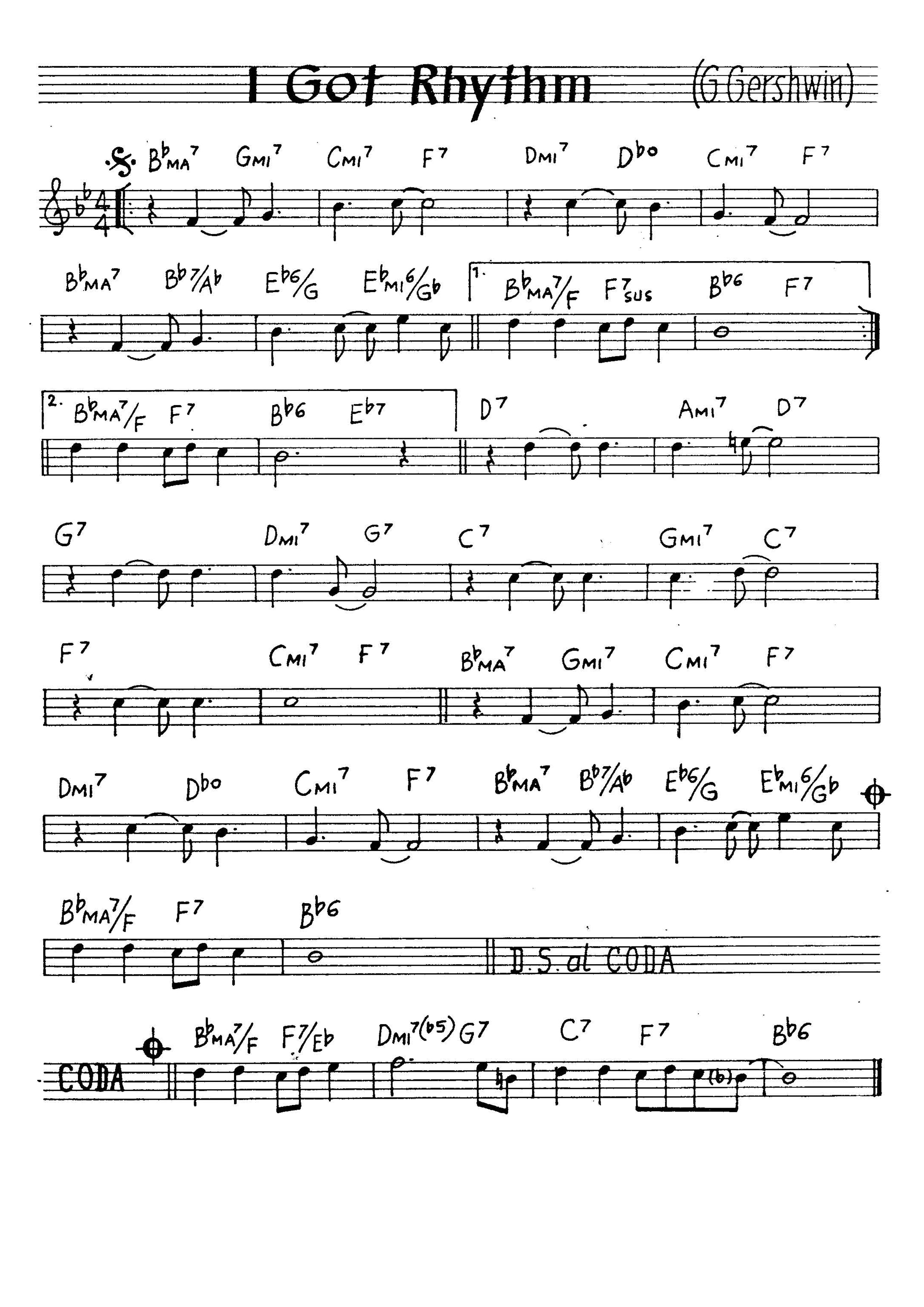

"I Got Rhythm" was composed by George Gershwin with lyrics by Ira Gershwin for the 1930 Broadway musical Girl Crazy. Popularized by Ethel Merman's show-stopping performance, the song quickly became one of the most influential compositions in jazz history.
Originally written as a 34-bar piece in D-flat major, jazz musicians typically perform it as a 32-bar AABA form in B-flat major, dropping the two-bar tag. The chord progression—known universally as "rhythm changes"—ranks alongside the 12-bar blues as the most essential harmonic framework in jazz. The A sections cycle through I-vi-ii-V patterns, while the bridge moves through a circle-of-fifths sequence. The pentatonic melody is deceptively simple, and bebop musicians developed countless harmonic substitutions and reharmonizations over this foundation.
The progression spawned an entire genre of "contrafacts"—new melodies written over the same changes. Charlie Parker's "Anthropology" and "Moose the Mooche," Duke Ellington's "Cotton Tail," Sonny Rollins' "Oleo," and Thelonious Monk's "Rhythm-a-Ning" are among the most celebrated examples. Mastery of rhythm changes remains a fundamental requirement for any serious jazz improviser.
The Real Book (6th Edition)
The ultimate jazz fake book. A must-have for all gigging musicians.
Check on Amazon.com