


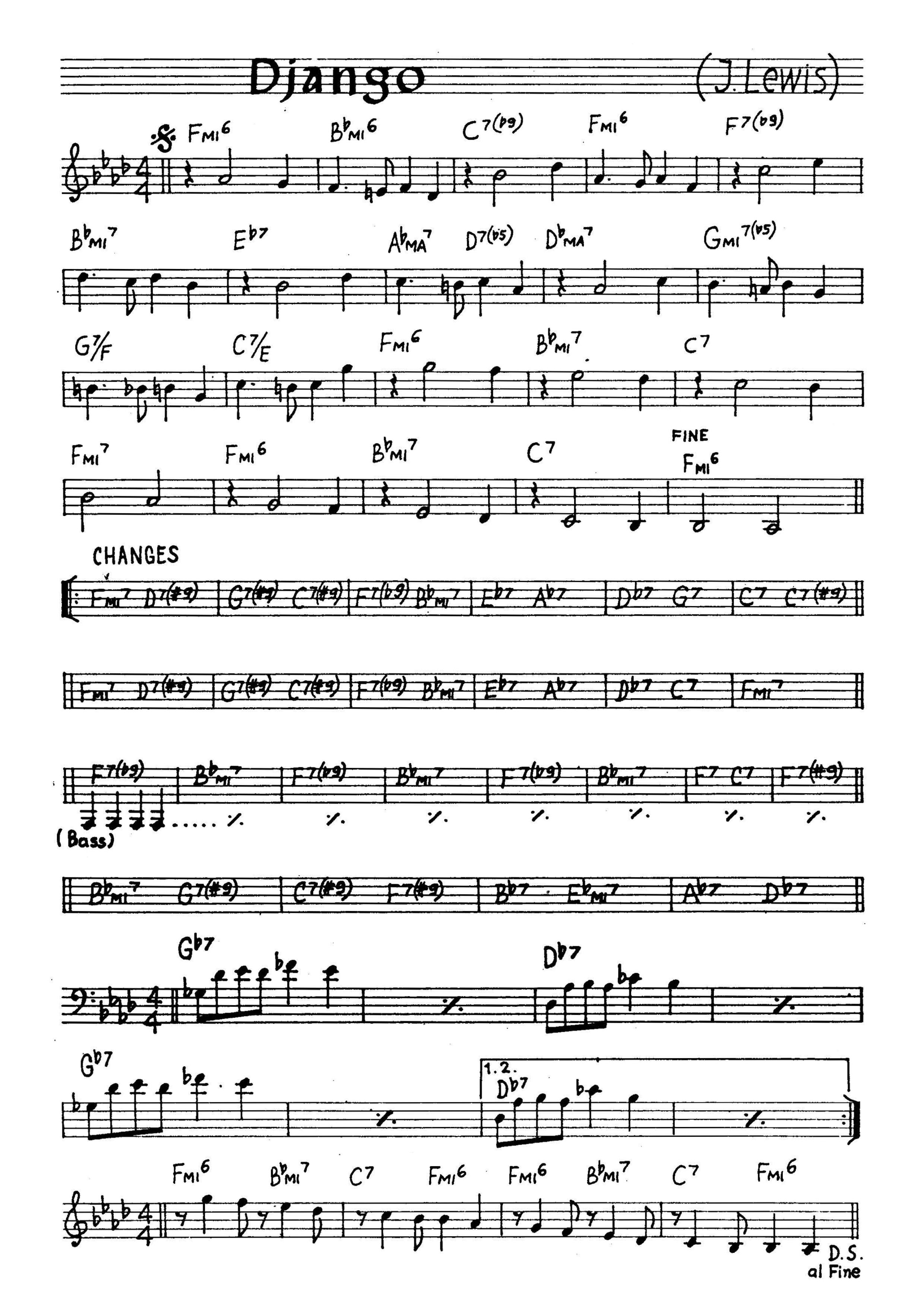

"Django" is a 1954 jazz standard written by pianist John Lewis, the musical director of the Modern Jazz Quartet, as a tribute to the Belgian-born Romani jazz guitarist Django Reinhardt, who had died the previous year. The composition became the MJQ's signature piece—bassist Percy Heath recalled that audiences would revolt if they didn't perform it.
The piece has a distinctive structure reflecting Lewis's classical influences. It opens with a solemn 20-bar theme in F minor that sounds like a eulogy, with a mournful melody accented by single bass notes. The solo sections follow a 32-bar cycle, but instead of a standard AABA form, they consist of two 6-bar A sections, an 8-bar B section, and a 12-bar A section whose final 8 bars shift to a boogie rhythm. A brief double-time interlude between solos builds anticipation. The piece concludes with a recapitulation of the opening theme. This architecture, described as having "perfect pyramid-like symmetry," fuses Bachian counterpoint with the blues in a way that is unmistakably John Lewis.
The original recording was made on December 23, 1954, by the MJQ—Milt Jackson (vib), Percy Heath (b), and Kenny Clarke (ds)—and released on the 1956 Prestige album Django. Bill Evans and Eddie Gómez offered a luminous duo rendition on Montreux III (1975), while Lewis himself revisited the piece as a solo piano performance on Evolution (1999).
The Real Book (6th Edition)
The ultimate jazz fake book. A must-have for all gigging musicians.
Check on Amazon.com