


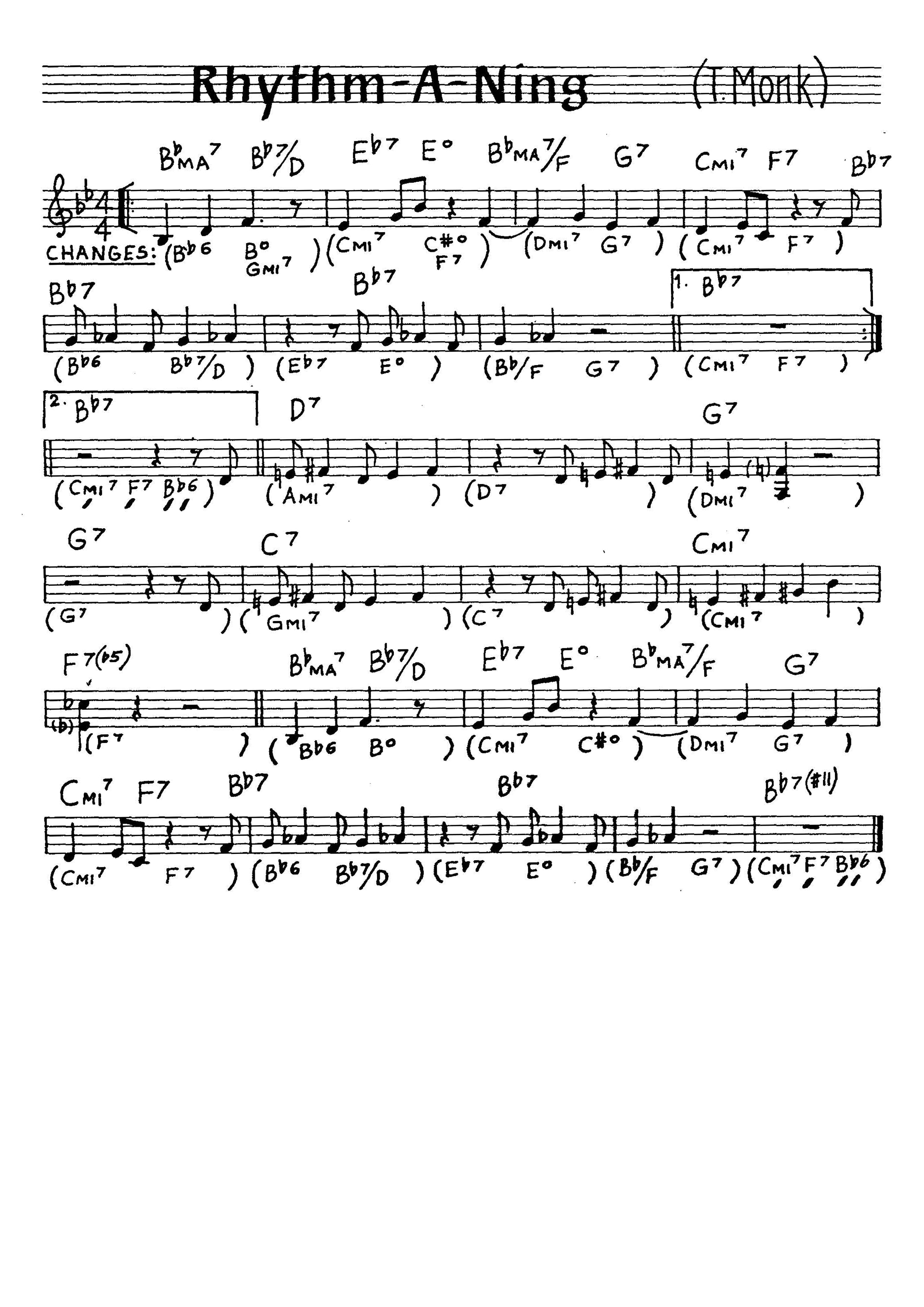

"Rhythm-A-Ning" is a composition by Thelonious Monk, first recorded on May 15, 1957. The title is likely a playful mispronunciation of "rhythming," perfectly capturing the tune's spirit of rhythmic invention. It has become one of the most frequently called rhythm changes tunes at jam sessions.
The form is a 32-bar AABA in the key of B♭, built on the ubiquitous rhythm changes progression derived from George Gershwin's "I Got Rhythm." The opening four-bar arpeggio riff—a figure that Mary Lou Williams used in her 1936 arrangement of "Walking and Swinging"—is followed by a series of rhythmically displaced three-note motifs that shift accents across the barline. What makes the melody remarkable is its oblique relationship to the underlying chords: it sounds utterly natural, almost like a nursery rhyme, yet it neither confirms nor contradicts the harmony in any obvious way. The bridge features the standard dominant seventh cycle (D7–G7–C7–F7) common to rhythm changes.
The earliest recording appears on Art Blakey's Jazz Messengers with Thelonious Monk (1957, Atlantic). A standout studio version is found on Criss-Cross (1963, Columbia), where Charlie Rouse on tenor saxophone trades ideas with Monk's characteristically angular comping. The tune appeared on virtually every live album Monk recorded after 1958, beginning with Thelonious in Action.
The Real Book (6th Edition)
The ultimate jazz fake book. A must-have for all gigging musicians.
Check on Amazon.com